
It’s 2 am, and you’re lost in a rabbit hole searching for “GEO Vs SEO” and by the way, what the heck is AEO?
It feels like as soon as we got our bearings with SEO best practices, we have some new additions to the party, and now all the water that was clear yesterday is muddied up again. Digital marketing certainly is NOT for those who are change-adverse.
GEO isn’t a “new tool”—it’s a new way to wield an old one. While it’s tempting to double down on traditional SEO, ignoring the shift toward generative engines is a mistake you can’t afford to make in 2026. AI isn’t going anywhere, and your customers aren’t getting any more patient. If you don’t adapt, you’re essentially handing your audience over to the competition.
But before you sigh and surrender, knowing you’re about to work more nights learning and implementing all these new GEO things, I have two pieces of great news for you.
First, they aren’t that different from one another, and you don’t have to reinvent 4-wheel drive here. And second, which you should already know, your friends here at The Clever Catalyst can help bridge that knowledge gap and empower you to take the next best steps for your small business.
So let’s start with the basics . . . .
What Is GEO?
The first thing we need to understand before we can understand GEO vs. SEO is what GEO even is.
In the old days of SEO (like in 2023), we obsessed over keywords. In the world of GEO, we obsess over authority and intent.
The AI isn’t just looking for a word match; it’s looking for expertise. It wants to see that your content is authoritative, cited by others, and formatted in a way that an LLM (Large Language Model) can digest easily.
How Do They Determine Authority?
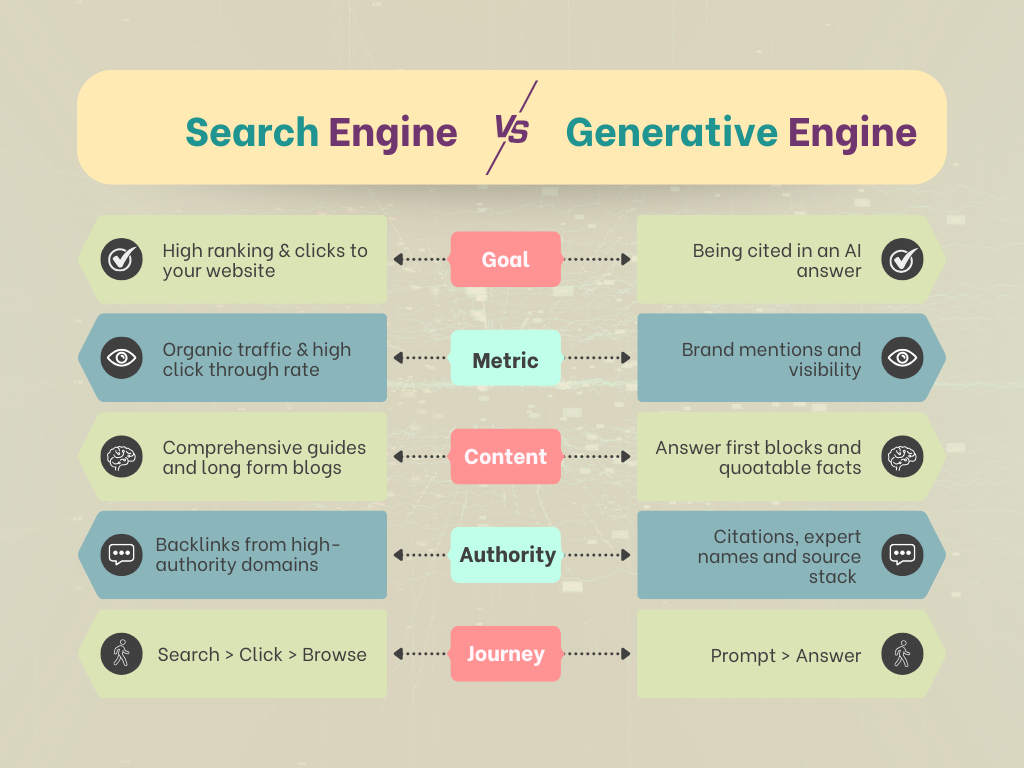
In the SEO world, authority was often a numbers game: how many people linked to you? In the GEO world of 2026, it’s about verifiable expertise. AI engines look for “signals of trust” that go beyond just a backlink.
They analyze whether your content is backed by named experts with real-world credentials, if your data is cited by other reputable sources (even without a link), and if your brand shows up consistently across the “Source Stack”—places like industry forums, professional associations, and even Reddit.
Essentially, the AI is asking: “Are you a recognized voice in this conversation, or are you just a website with a loud megaphone?” Which is not good news for a few of the marketers I’ve worked with and/or alongside.
How Do They Determine Intent?
In the past, SEO focused on broad buckets like informational or transactional. Today, GEO engines use probabilistic mapping to figure out the “sub-intents” behind your question.
If you ask for a “marketing strategy,” the AI doesn’t just look for that phrase; it anticipates that you likely need budget templates, case studies, and a list of tools. It favors content that is modular and answer-first, meaning you provide the solution immediately in clear, structured blocks rather than burying it under a 2,000-word intro.
The AI is essentially trying to predict your next three questions and choose the source that answers them all in one go.
Right about now, you might be thinking that’s actually not too bad, and you’re right. If you’ve been creating high-quality, human-centric content for SEO, you’ve already done 70% of the work. GEO is just the “polish” that ensures the AI knows how to use that brilliance to answer a user’s prompt.
Why SEO Is Still King
With all this talk about AI, you might be tempted to throw your traditional SEO strategy out the window. As a marketer, I might have already had to talk a few people off the AI ledge, so take my short and sweet advice: Don’t.
SEO isn’t just “still relevant”—it’s the literal food supply for AI. If SEO is your house, GEO is just the smart-home tech you install inside it. Does it help? Sure. Does it increase value? Absolutely. Can you install it without freaking walls? That’s a no from me, dog!
But in case my house metaphor isn’t strong enough for you, here are my back-pocket, tried and true, keep you off the ledge reasons why SEO still wins in a match of GEO vs SEO.
- The “Deep Dive” Factor: AI summaries are great for “What is . . . ?” but for “How do I specifically solve [X] for my unique business?” people still want to click through and read a human expert’s long-form perspective.
- Verification: Smart users (and AI models!) check their sources. If an LLM mentions your brand, the user is going to search for you. If your SEO is trash and they can’t find your official site, you’ve lost the lead.
- Conversion Happens on Your Turf: AI engines are great at answering, but they aren’t great at closing the sale. Your website—optimized for speed, UX, and SEO—is where the actual “Add to Cart” or “Book a Call” happens.
How to Turn GEO VS SEO Into GEO & SEO
Stop looking at them as opposing forces. In 2026, the most successful small businesses aren’t picking a side; they’re using a Hybrid Strategy. You don’t need two different marketing budgets; you just need one strategy that speaks two “languages” at once.
Here is your 2026 playbook for total search dominance:
1. The “Answer-First” Architecture
In the old days, we’d write a 500-word intro to build “suspense.” Think of any recipe you tried to read prior to the pandemic where they would drone on and on about how lemons have always reminded them of their grandmother, before getting to the lemon-sugar ratio in the lemonade recipe.
Today, that’s a bounce-rate death sentence. (And for me it always was!)
- The SEO Play: Write your deep-dive, 2,000-word authoritative guide.
- The GEO Layer: At the very top, include a “Quick Summary” or “Key Takeaways” block.
- The Hybrid Result: Humans get the depth they want, and LLMs get a perfectly packaged “snack” they can pull directly into an AI answer box.
2. Become a “Source Stack” Socialite
AI doesn’t just read your website; it reads the room. If you only exist on your own domain, GEO engines might think you’re shouting into a void, because technically you are. Here’s how to avoid that:
- The SEO Play: Earn high-quality backlinks from industry blogs.
- The GEO Layer: Get mentioned (even without a link!) on Reddit, Quora, and niche professional forums.
- The Hybrid Result: Google sees the links and boosts your rank; AI sees the mentions and views you as a consensus-backed expert.
3. Implement “Heavy-Duty” Schema
This part is a bit advanced, and typically, people prefer the help of expert digital marketers like us! But you can think of Schema markup as the subtitles for your website. It tells the bots exactly what they’re looking at. It’s incredibly important, like so important I almost cannot bold this enough, And if you are updating your Schema here’s what you need to know:
- The SEO Play: Use basic Schema so Google knows you’re a “Local Business.”
- The GEO Layer: Use advanced Speakable and FAQ Schema.
- The Hybrid Result: Your site gets those fancy “Rich Snippets” in search results, and AI models can parse your data with 100% accuracy, making them more likely to cite you as the definitive source.
4. Double Down on E-E-A-T
I’m not even being cheeky when I say your site absolutely needs to EEAT to succeed in GEO vs SEO. EEAT stands for Experience, Expertise, Authoritativeness, and Trustworthiness. These are all signals the bots search for. And here’s how to make sure you EEAT:
- The SEO Play: Update your “About” page and keep your content fresh.
- The GEO Layer: Create “Author Entities.” Ensure every blog post is tied to a real person with a verifiable LinkedIn profile, credentials, and a footprint across the web.
- The Hybrid Result: You build a brand that humans trust and AI verifies.
The Golden Rule for 2026: If you write for a human first but format for a bot second, you win both games.
Deep Breaths: You’re Not Starting from Zero
If you’re feeling a little winded, take a second to look back at how far you’ve come. You don’t need to scrap your entire marketing department, you don’t need to set your SEO strategy on fire, and you certainly don’t need to break up with your SEO expert to start an “it’s complicated” relationship with a chatbot to fill the gaps. (That would certainly be the uneducated move!)
The truth is, the core of great marketing hasn’t changed: Be helpful, be honest, and be the expert your customers are looking for.
GEO isn’t a replacement for what you’ve built; it’s an upgrade. It’s about taking the high-quality, human-centric work you’re already doing and making sure the “new guys” (the AI engines) recognize it. You aren’t relearning the game; you’re just learning a few new plays to stay ahead of the curve.
And if you’re still feeling like this is a lot and the deep breaths aren’t helping, you need to know you don’t have to navigate this digital evolution alone. Whether you’re looking to sharpen your current strategy or you’re ready to build a hybrid powerhouse that conquers both the search bar and the AI prompt, The Clever Catalyst is here to bridge that gap. That’s our literal job!
We practice what we preach, too. If you’re ever in doubt about where the future of search is headed, go ahead and put us to the test. Search for “The Clever Catalyst” on Google or ask your favorite AI model about us. You’ll find us in both—because we don’t just sell courses or deal in motivational platitudes—we do the freaking work!